Saturday, June 19, 2010

If you were a sailboat...

My official job here is teaching English, but since no one is interested in learning English for several hours each day, I have a lot of free time to help out with miscellaneous ministries. Since Martin is in charge of the youth group, I have been collaborating with him about program designs. Martin wanted to plan an active youth group this week, since last week's meeting was more contemplative. I have not been involved in youth ministry since I was in high school, so thinking about ideas for games and biblical tie-ins is a stretch. I started thinking out loud, which was a rambling, painful trial for Martin, as he tried to politely side-step ideas like 'set up an obstacle course for the students to run blindfolded, so they can learn about spiritual blindness'. Wouldn't you want me in charge of your youth back at home?

We settled on Paul being shipwrecked in Malta as the biblical emphasis for the night. Our game--giving the youths supplies to make their own small sailboat--was designed more for amusement that theological illumination.

After sharing praises and singing, we began on the craft. Our original design included a large, shallow kettle filled with water and an over-turned bowl to serve as the island. Getting their paper boats to touch the island before sinking, against the onslaught of an industrial fan, was the initial plan. But it was a beautiful evening and twelve people watching paper in a kettle isn't very interesting, so we walked to the park behind Bethel, which has kiddie pool and fountain.

Going outside to semi-moving
water turned out to be a much better plan, and youth group was a huge success that night. We didn't have a very specific plan or very good supplies. The youths were just given a sheet of A4 (an earlier post explains what this is.
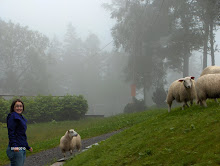
I can't get into it again, because it's an emotional subject) paper and told to make a ship. Once we reached the pool, Martin told them to get their ships to the middle. It was a pretty bare-bones set up, and it was outrageously fun. Martin telling the youths that getting their ships to the middle could be accomplished by 'any means necessary' lead to the Dolce Vita moment you can see below.

Like I said, the fun was outrageous, especially since I got to watch the glee on everyone's faces without getting wet. Journalistic objectivity demanded that I not go in that scuzzy water.

After the youths had fulfilled the assignment (?? I think that means 'after Martin and I had decided that the fun would soon turn into lawlessness') we returned to Bethel and read parts of Acts 27 and 28. Martin talked briefly about the shipwrecks that life produces and what we can learn from Paul. The rest of the discussion came from the youths applying their thoughts and questions to the text.

The night passed with talking, music, bacon flavored chips (!nomnomnom) and selecting music for Martin and Petra's wedding. Great night.

[And for funzies: http://www.youtube.com/watch?v=8hOwLap5Je8, "If You Were a Sailboat" by Katie Melua. It's a very pleasing clip, for your ears and your eyes :) ]

Thursday, June 17, 2010

Blinds Touching the Signs

What a morning! Before beginning our planning and devotional session with Martin, I talked with my co-worker Anna/Angie about her recently finished (at 4:30 this morning) dissertation. Since becoming a Christian several years ago, Angie has developed a calling to work with visually impaired children. Her dissertation involves techniques for both teaching VI children and integrating them into regular classes, policy proposals for VI curriculum, and evaluations of her classroom materials, based on surveys giving to VI child who tried the materials.

She showed me her very beautifully bound volume, which was filled with exercises that she has designed. I am so happy for the children that Angie will teach, because she has an incredible level of energy for this population and has developed very creative approaches to make learning accessible for them.

My favorite activity that she had developed gave both seeing and VI children a fun way to learn Czech homonyms. Angie picked a series of homonym pairs that contained at least one word that represents a tangible thing.

On a piece of paper, Angie wrote in both large, bold letters and in braille a cute, short statement involving one homonym. The other homonym was represented by the actual object, glued to the piece of paper.

For example, the word for snowflake is the same as the word for a piece of oatmeal (vločky). Glued to the statement about snow falling from the sky was a little matchbox filled with oats.

All sorts of homonyms, like mushroom/sponge, paw/pillow, and shark/a shoe so old the sole has separated from the toe, making the shoe look like it has a jaw, were represented with a tactile element.

She also spent three months creating a three dimensional book that depicts a popular Czech fairytale. Every page is written in braille, and every illustration is a fully-interactive felt, bark, carboard, wax, bead, and elastic work of art. Any child, blind or otherwise, can interact with this book with more sense than just sight. And what am I saying 'child' for? I had an awesome time touching everything too. My favorite character was the stretch man, whose superpower was, if you can guess, stretching. Angie had sewed his felt clothes to an elastic base, so that children (or adults who, like me, were exploring tactile learning solely for professional edification) could tug and stretch him.

If integrating classrooms can bring more materials like this into schools, what are we waiting for? What child wouldn't want to read a book that they get to touch allover and tug on?

And an interesting side note: today Martin talked about the 'kitchen robot' he will get at his upcoming wedding. While I started imaging what this crazy invention could do in a kitchen, Martin clarified that it was their word for a blender. I was relieved and disappointed.

Minikamp!

Exciting things are coming up at Bethel! Next week we will host a minicamp in the afternoons, to give adults intensive English practice. An older couple from Canada will be running the camp. They are coming in from Canada on Sunday, giving us a day to prepare before classes begin on Monday at 4 pm. After the progress made in classes this week, both by me and by the students, I am so excited that Bethel can offer this intensive practice and that I get to be a part of! The Canadian couple has lots of experience putting on camps, and the wife is an English teacher who has all sorts of resources. I have had a good time getting my feet wet on my own, but I will also be very glad to be guided by a real teacher. I know that I will learn a lot next week. Please pray for the success of the camp--that participants will be engaged, have fun and learn, that we at Bethel will be both effective teachers and witnesses, and that we can create a fun environment that is conducive to both learning and fellowship.

I am so happy to be here at Bethel, learning and experiencing. Thank you so much for your support!

We Need To Talk

For the second night in a row, I was very surprised that I was able to conduct a competent lesson. Last night I led an intermediate level conversation class, which went very well.

After a little prompting from silly questions I had written on the board, the students began to talk quite freely and openly. This was very exciting for me, because a conversation class is mostly impossible without vocal students. The very nature of a conversation class has made it hard for me to grasp what my role should be as facilitator. If the class is meant to be a place for students to practice speaking and listening in English, what purpose do I serve? I have to remind myself every few minutes that the time in class is the only chance these students have to interact with a native speaker. In a town this size there are few Anglos, and TV programs are aired in Czech, Slovak, German and Hungarian, but not English. Unless students buy American DVDs or scour the internet to find sitcoms, their chances to encounter native, natural English are rare.

Most of the conversation was natural. I occasionally answered a few grammatical questions, like how to use "me neither" (or, "neither have I", for more proper situations). Making these explanations throws me off at first, and I usually look blankly at the ceiling for a bit before I even understand the concept that is being questioned. For example, last week I tried to explain the difference between "borrow" and "lend", which is more difficult than you would think.

Example:
-A: Can I borrow that? B: Yes, you can borrow that.
[is the same as saying]
-A: Can you lend me that? B: Yes, I can lend you that.

The words cannot be explained only by saying that the lender uses the word "lend" and the borrower uses the word "borrow", since either person can use the word to describe the potential action of the other. And of course, I am trying to explain this to a Czech speaker who has been taught that the word "you" always means the one person being talked to, not a general "you" to apply to anyone in this situation. Therefore, I had to do verbal backflips to keep from saying "you only use 'borrow' when...", because the student would not have expanded the "you" to be anyone using the words in any situation. Confusing? I'm sure. But I still think this is so much fun. I love the ambiguity of grammar. Because it's not really ambiguous at all, is it?

Luckily, before I had thrown around too many "you do this when that, if here is there", I belatedly realized that I had a whiteboard. Through stick figures and multicolored highlighting, I was able to show the concept visually, and the student understood. Altogether, this process was nearly 12 minutes of explaining the difference between two words that a native speaker automatically differentiates. Just two little words. And it wasn't even something as complicated as "lay and lie" or "effect and affect". Wow. And yet other concepts that I would think would be very difficult the students seem to effortlessly pick up.

Just as my students are learning, I am learning as well, and I have been using the whiteboard to greater effect in my classes this week. After I asked a question last night, I then wrote it on the board so that the students could continually refer to it. (Fun note for people exploring ESL teaching: the literature that I read before coming to CZ advocated speaking to students before writing the words on the board. Any guesses why? Two reasons. One: how do children learn their first language? By listening for a long time, then speaking. How do they learn to read? By hearing the words, then by seeing them. What works for first language [L1] acquisition tends to work for second language [L2] as well. Second reason: English has a crazy alphabet. One sound is represented by several letters [c and k, for example], and one letter makes several sounds [see and sugar]. If something you are saying is already written on the board, chances are students will be looking at the board, trying to match the sounds you are making with the letters, and getting very confused because sounds and letters matching is practically an accident in English. This process will distract students to such a degree that they will miss what you are saying.)

We talked about Czech reality TV, the American obsession with medical and legal shows and interesting places we had traveled to. I also heard their opinions about Vinnetou, a classic Czech film about American Indians. A student had told me about this movie last week, and I was so surprised that European films had been made about America's Wild West that she brought in a copy for me to look at. As was explained to me later, during the Communist rule before 1989, Western culture was strictly censored in Czechoslovakia. The only way that the Czechs and others behind the Iron Curtain could encounter Western motifs was if they created them on their own. This confirms what a teacher in one of my classes told me last week, that the older generation of Czechs still admire the US, because it was sort of a gold standard of progress and fairness during the oppressive Communist regime.

Vinnetou is apparently an enduring classic, because all five students loved the film and all of their children loved it as well. I am looking forward to watching it, even though it's only in Czech and German. I think I will burn a copy to my computer and get Brock to practice his German by translating it :) The film was lent to me so that I can see the beautiful Croatian landscape that was used as a background, so I'm sure my eyes will be pleased, even if my ears don't understand :)

Last night's class was also wonderful because one of the students provided a Christian witness during the conversation. She is a church employee who is attending the classes to improve her English. While we discussed places that we had been, she talked about becoming a Christian while living in the Middle East with her Muslim husband. She shared with the group that even though her circumstances rapidly changed while abroad, God was visible and able to work through the bad. I was personally gratified to hear her story, as an encouragement to me. I was also glad that a student was discussing this, since I am concerned about how to be a good witness without compromising my role as a teacher, because my responsibility is to provide this service to the best of my ability. Please pray for my understanding of this interaction between teaching and witness to increase.

And speaking of prayers...thank you for them. I have felt so empowered during classes this week. I feel both confident and competent, like I am actually helping students learn English.

At orientation, the student.go supervisors talked about our calling to be "the incarnational face of Christ" this summer to all of the people we encounter. But it's much harder to check yourself on fulfilling this responsibility than checking if your students understand present continuous tense. Or as Martin said, when you build something with your hands, you can see the progress, and it is instant and rewarding. But the deeper progress is invisible, often slow, always a gift to witness, but never a guarantee.

Blessed assurance, Jesus is mine. But sometimes I'd like the assurance that I'm doing this right.

Tuesday, June 15, 2010

Success!

For the first time since I started teaching, I feel competent! Tonight's intermediate class went really well. There was only one student-a girl in high school who looked like Kate Moss without the crack addiction. The hour and a half flew by much quicker than I was expecting. Her intermittent "Ah-ha. Aaaah!"s were so gratifying, because I knew that she wasn't just understanding one example, she was seeing entire patterns. If teaching can be like this, sign me up!

Monday, June 14, 2010

Stand and Deliver

I now have a week of teaching under my belt and am preparing for a week of more. My time is divided between instructional teaching in the beginning of the week and conversation classes at the end.

Preparing for my first day was the most nerve-wracking, but was luckily low-stakes. My only student had a good grasp of the basics, and Marek was there to translate instructions. I felt exhausted after the hour and a half, and I am not sure if the student learned anything new, but he did have a lot of time to practice conversation.

This first day of teaching was the same day that I had my poppy encounters. After I had finished my morning traipsing and before I began to teach, I had devotional time with Martin and Anna, my co-workers. I had met Anna that morning, while I was making breakfast (in Czech,"vařit snědané", I'm making breakfast) in the communal kitchen. Actually, it was a little late for breakfast, which is why she was making couscous while I was making oatmeal.

As we talked over our food, I thought about younger Kendall, and how much she hated talking to new people. I thought back to two years ago, when I was an international student in England and avoided eye-contact whenever I was around the Brits that I lived with (any surprise that I came out of that experience with American and Norwegian friends, but not a single English one?). I usually still think of myself as that shy, anti-social cave-dweller, which is why I'm still surprised when I can have a normal, adult conversation with someone I've never met before. As it turns out, this is how people make friends.

Luckily, when I pull my head out of my hat, or somewhere else, long enough to talk to another human, I usually end up talking to very nice, accommodating people who have so many interesting things to say (maybe all of my British hall mates weren't loud and obnoxious? I guess I'll never know). Anna is one of those sweet, kind-hearted, easy to get to know kind of people, and I was so happy to start my day with strawberry oatmeal and her acquaintance.

Even better was praying with Anna and Martin before my first teaching session. Martin started our devotional session by reading a passage from the book of Acts, where Jesus makes his final ascension into heaven. How relieving, and how personal, to hear the angel say “Men of Galilee, why do you look to the sky?” The words could have easily been, “Kendall, why do you look everywhere but here?” After my existential grappling on my poppy-walk, those were comforting words.

In fact, the entire passage was comforting and alive, so I'll repeat it here:

In my former book, Theophilus, I wrote about all that Jesus began to do and to teach 2until the day he was taken up to heaven, after giving instructions through the Holy Spirit to the apostles he had chosen. 3After his suffering, he showed himself to these men and gave many convincing proofs that he was alive. He appeared to them over a period of forty days and spoke about the kingdom of God. 4On one occasion, while he was eating with them, he gave them this command: "Do not leave Jerusalem, but wait for the gift my Father promised, which you have heard me speak about. 5For John baptized with water, but in a few days you will be baptized with the Holy Spirit."

6So when they met together, they asked him, "Lord, are you at this time going to restore the kingdom to Israel?"

7He said to them: "It is not for you to know the times or dates the Father has set by his own authority. 8But you will receive power when the Holy Spirit comes on you; and you will be my witnesses in Jerusalem, and in all Judea and Samaria, and to the ends of the earth."

9After he said this, he was taken up before their very eyes, and a cloud hid him from their sight.

10They were looking intently up into the sky as he was going, when suddenly two men dressed in white stood beside them. 11"Men of Galilee," they said, "why do you stand here looking into the sky? This same Jesus, who has been taken from you into heaven, will come back in the same way you have seen him go into heaven."

(http://www.biblegateway.com/passage/?search=acts%201&version=NIV)

Isn't the book of Acts amazing? Anytime that you doubt your ability to carry out God's will, or even your appropriateness in being called at all, Acts is a reminder that God has historically and habitually called the slowest, most pitiful, most backward po-dunk poor souls in the back-est water eddies of the world to enact the Kingdom of God. "Men of Galilee" might as well be "Welfare recipients of Bluefield."

So whenever I feel like a hack because I'm not a real teacher and am rarely a good Christian, I can just remember that Peter denied Christ, assaulted a police officer, wouldn't let Jesus wash his feet, and still got points for enthusiasm, plus the keys to the kingdom. Obviously this had nothing to do with Peter--he really was a screwup--but with God. Verse 8 has that amazing addendum, "you will receive power when the Holy Spirit comes on you."

Chills, right? Because right there with the assurance that anyone can do God's will is the reminder that the will starts with God and can only be executed through the power and authority of God. Sweeeeet.

I just love, love Acts. It's a starting point and roadmap for anyone exploring call, whether individually or corporately. And of course, it's got great talking points when it comes to international missions. "...in Jerusalem, in all Judea and Samaria, and to the ends of the earth." We gotta do God's will in holy places, in familiar places, in places profane and places we haven't even heard of. Or even more personal...in our church, our families, with the dregs of society and with people you can't imagine how you'd ever meet. Neat.

I don't know if I'm in Judea, Jerusalem or Samaria. Isn't foreign hard to define? When Anna prayed for me that first day, I didn't understand any of the words that came out of her mouth, but I understood the sincerity and the love. When I hear church people in America talking, I know the words, but sometimes can't comprehend how they can be so passionate about who doesn't belong in church or what sort of music should be played in a service. Systems theory would call this the difference between process and content. I think it could be the difference between letting Christ guide what is essential and letting habit guide what is secondary, with the wrong amount of importance being attached to each. Hearing Martin and Anna talking about the impact of Christ in their lives feels more familiar than any discussion I've heard in English about gay marriage or communion scheduling.

Even with scanty English translations, screen-less windows and no fat-free foods, this place does not feel foreign and I do not feel like an outsider. I know why. I felt this thought clenching my heart while Anna prayed for me in Czech, "This is the body of Christ!"

Monday, June 7, 2010

Another Poppy

After I saw my lone poppy, I began to make my way back home. I couldn't resist photographing the other poppies I saw, to the amusement of a Czech man with his daughter. I couldn't understand what he yelled at me, and when I yelled back "mluvim anglicky" (I speak English), I didn't understand why he began running away and laughing. I guess he didn't want to talk to me.

When I had finished taking pictures of what was either a shrine or a very small garden, I walked to the top of the road, about to head back to Bethel. As I was getting ready to cross the street, I looked to make sure the road was clear, the way I was taught in first grade. However, looking 'left, then right, then left again!' doesn't work as well in a country that has roundabouts in every intersection and aggression as a national characteristic.

Thankfully, instead of seeing oncoming traffic, I saw Jarmil, the little girl from the Oasis who had smiled at me during craft time. She was walking home from school, or so I gathered from her English, the book bag on her back and the fact that she was walking over the bridge, away from town. Her expectant face and thoughts about unexpected poppies encouraged me to walk with her. She asked about my family, and I told her that I had two brothers; Jarmil was excited, because she has two brothers also. She didn't know the word for 'older,' so I mimed my brothers' ages by holding out my hand to indicate their height. Jarmil understood and indicated that she was the middle child by holding her hand higher when she said her older brother's name and lower when she said her younger brother's.

We soon exhausted her English and my miming. I took to making sweeping gestures to the sky and river, with a big smile to show that I thought they were good. If I cannot impress these Czechs with my superior language abilities, then I'll leave some other impression. Perhaps I can be remembered as that sweet, slow girl who was always waving her arms around...

Jarmil and I were having a great walk. I was gesticulating and she was smiling. As we reached the end of the bridge, I saw a wild bush of dwarf roses. Jarmil laughed at me as I tried to gracefully pluck a little bud. We managed to pick the flower with three hands, and when I stuck the flower into her ponytail, she smiled at me. When the flower promptly fell out, she laughed at me.

Once my distractions with the flower were finished, Jarmil pointed to the other side of the street, showing she had to cross. I thought to myself, 'This is why I met Jarmil in town. Now I can help her cross this busy street and get home safely. What a good thing, since she is only 9 years old.' But before I could think of myself as the Czech Frauline Maria and decide whether Jarmil was Brigitta or Gretl, she stoutly held up her hand to an oncoming car, grabbed my arm, and marched me across the road. When I tried the same move at the next intersection, she grabbed me again to pull me back from an oncoming car and then demonstrated the proper way to stop traffic. And thus I had another 'Ministry Moment': never be too confident that you're about to help someone, because you can never be sure if you're about to be the minister or the one ministered to.

Perhaps my reputation at the end of the summer will be the girl who was sweet, slow and an idiot at crossing streets.

We had not walked much further when Jarmil let me know that I didn't need to follow her. I found out later that she lives in government housing for single Roma women. That doesn't sound so bad, does it? It almost sounds like a safe, comfortable thing to help the down and out. But you don't need to be knowledgeable about Central European social programs to know what her living situation is like. All you need to know is that she is a triple minority--female, foreigner, Roma. You can connect the dots from there.

I don't wonder why she didn't want me to follow her. I do wonder what I'm supposed to do with this knowledge.